The History of Hajj: From Prophet Ibrahim to Today
Hajj is one of the five pillars of Islam, and its significance is immense in the lives of Muslims around the world. It is an act of worship that encompasses spiritual purification, devotion, and submission to Allah.
Muslims perform Hajj to follow the footsteps of Prophet Ibrahim (Abraham) and his family, re-enacting the profound events that took place more than 4,000 years ago. But the story of Hajj did not begin in the time of the Prophet Muhammad (PBUH); it has deep roots stretching back to the time of Prophet Ibrahim, and its legacy continues to this day.
This article will take you on a journey through the history of Hajj, exploring its origins, its significance, and the evolution of the pilgrimage from the time of Prophet Ibrahim until today. We will reference the relevant Quranic verses and Hadiths to provide a comprehensive understanding of this sacred journey.
The Origins of Hajj: The Story of Prophet Ibrahim
Hajj, in its essence, is rooted in the story of Prophet Ibrahim (PBUH). He was a pivotal figure in Islam, and his life and actions have had a lasting impact on the Islamic faith.
The Quran mentions Ibrahim’s devotion to Allah and his willingness to sacrifice everything for Him, including his beloved son, Isma’il (Ishmael). One of the most significant events that laid the foundation for Hajj was when Allah commanded Ibrahim to build the Kaaba, the house of worship, in the city of Makkah.
Allah (SWT) says in the Quran:
“And [recall] when We pointed to Ibrahim the site of the House, [saying], ‘Do not associate anything with Me and purify My House for those who perform Tawaf and those who stand in prayer and those who bow and prostrate.”
(Surah Al-Hajj 22:26)
Arabic:
وَإِذْ بَوَّأْنَا لِإِبْرَاهِيمَ مَّكَانَ الْبَيْتِ أَنْ لَا تُشْرِكْ بِي شَيْئًا وَطَهِّرْ بَيْتِي لِلطَّائِفِينَ وَالْقَائِمِينَ وَالرُّكَّعِ السُّجُودِ
Transliteration:
Wa idh bawwana li-ibraheemamakānal-bayti an lā tushrik bī shay’an waṭahhir baytī liṭṭā’ifīn wa-l-qā’imīn wa-l- ruk‘ī s-sujūd.
This verse refers to the command given to Prophet Ibrahim (PBUH) to purify the Kaaba and establish it as a place of worship for all believers. Ibrahim and his son Isma’il (PBUH) then worked together to build the Kaaba in Makkah, and it became the focal point of worship for those who followed the faith of Ibrahim.

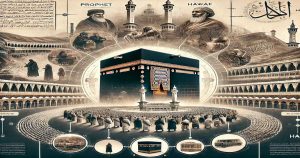
The Kaaba: The Spiritual Heart of Islam
The Kaaba, which is located in the Masjid al-Haram in Makkah, is the most sacred site in Islam. Its structure is a cube-shaped building made of stone, and it is covered by a black silk cloth known as the Kiswah. Muslims around the world face the Kaaba during their daily prayers (Salah), and it is the destination of millions of Muslims who perform Hajj each year.
The Quran mentions the Kaaba as the first house of worship dedicated to Allah:
“Indeed, the first House [of worship] established for mankind was that at Bakkah [Makkah], blessed and a guidance for the worlds.”
(Surah Aal-e-Imran 3:96)
Arabic:
إِنَّ أَوَّلَ بَيْتٍ وُضِعَ لِلنَّاسِ لَلَّذِي بِبَكَّةَ مُبَارَكًا وَهُدًى لِّلْعَالَمِينَ
Transliteration:
Inna awala baytin wudi‘a lil-nāsi lalladhī bibakkata mubārakan wa hudan lil-‘ālamīn.
This verse highlights the profound significance of the Kaaba. It was built by Prophet Ibrahim and his son, and it stands as a symbol of unity and devotion for Muslims across the world.
The Role of Hagar and Isma’il
While Ibrahim’s (PBUH) devotion to Allah is central to the establishment of Hajj, the involvement of his wife, Hagar (Hajar), and their son, Isma’il (PBUH), also plays a crucial role.
After Ibrahim (PBUH) was commanded to leave Hagar and their young son Isma’il in the barren desert of Makkah, it was Hagar’s faith and perseverance that became key elements in the establishment of Hajj rituals.
Allah commanded Ibrahim to leave his family in the desert, and when the water in the desert ran out, Hagar ran between the hills of Safa and Marwah searching for water. It was through her perseverance that the well of Zamzam miraculously sprang forth, providing water for her and her son.
Allah (SWT) says in the Quran:
“And [recall] when Ibrahim said, ‘My Lord, make this a secure city and provide its people with fruits – whoever of them believes in Allah and the Last Day.’”
(Surah Al-Baqarah 2:126)
Arabic:
وَإِذْ قَالَ إِبْرَاهِيمُ رَبُّ اجْعَلْ هَٰذَا بَلَدًا آمِنًا وَرَزُقْ أَهْلَهُ مِنَ ٱلثَّمَرَٰتِ مَنْ ءَامَنَ بِٱللَّهِ وَٱلْيَوْمِ ٱلْءَاخِرِ
Transliteration:
Wa idh qāla ibrahīm rabbu aj‘al hādhā baladan āminan wa ruzuq ahluhu mina alththamarāti man āmana billāhi wa al-yawmi al-ākhir.
This prayer of Prophet Ibrahim was answered by Allah, and the city of Makkah was blessed with security and sustenance, thanks in part to the faith and sacrifice of Hagar and Isma’il.
The Rituals of Hajj: Origins and Significance
The key rituals of Hajj, including Tawaf (the act of circling the Kaaba), Sa’i (the act of walking between the hills of Safa and Marwah), and the standing at Arafat, are all rooted in the events that took place in the time of Ibrahim (PBUH).
-
Tawaf (Circumambulation of the Kaaba)
The act of Tawaf is performed by walking around the Kaaba seven times in a counter-clockwise direction. This act is a way to show submission and devotion to Allah, symbolizing the unity of the believers in the worship of the One God.Allah (SWT) says in the Quran:
“And [remember] when We made the House a place of return for the people and a place of security.”
(Surah Al-Baqarah 2:125)Arabic:
وَإِذْ جَعَلْنَا ٱلْبَيْتَ مَثَابَةً لِّلنَّاسِ وَأَمْنًا
Transliteration:
Wa idh ja‘alnā al-bayta mathābatan lil-nāsi wa amnan. -
Sa’i (Walking between Safa and Marwah)
Sa’i is a symbolic act commemorating Hagar’s desperate search for water for her son Isma’il. During Hajj, pilgrims walk between the two hills of Safa and Marwah, symbolizing her perseverance and trust in Allah. -
The Standing at Arafat (Wuquf)
The culmination of Hajj is the standing at Arafat, where pilgrims gather to supplicate, ask for forgiveness, and reflect on their sins. This act commemorates Prophet Ibrahim’s (PBUH) devotion to Allah and his submission to divine will.
The Prophet Muhammad (PBUH) said:
“Hajj is Arafat.”
(Sunan Ibn Majah)
Arabic:
«ٱلْحَجُّ عَرَفَةُ»
Transliteration:
Al-ḥajj ‘Arafah.
This Hadith highlights the central importance of Arafat in the rites of Hajj. It is a time for pilgrims to seek forgiveness and to reflect on their faith.
The Evolution of Hajj Through the Ages
From the time of Prophet Ibrahim (PBUH) to the time of Prophet Muhammad (PBUH), the practice of Hajj remained largely unchanged. However, after the death of the Prophet Muhammad (PBUH) and the spread of Islam throughout the world, the practice of Hajj saw a variety of developments.
-
The Time of the Prophet Muhammad (PBUH):
During the time of Prophet Muhammad (PBUH), Hajj was performed annually, and the rites were performed according to the instructions given by the Prophet. He clarified the details of the pilgrimage through his actions and words, providing guidance for future generations of Muslims.The Prophet Muhammad (PBUH) said:
“Take your rites of Hajj from me.”
(Sahih Muslim)
Arabic:
«خُذُوا۟ عَنِّي مَنَاسِكَكُمْ»
Transliteration:
Khudhū ‘annī manāsikakum.
-
The Time After the Prophet:
After the death of the Prophet Muhammad (PBUH), the caliphs and scholars continued to ensure the proper performance of Hajj, maintaining the established rituals. Over time, the pilgrimage grew in scale, with more Muslims from all corners of the world traveling to Makkah. -
Modern Hajj:
In modern times, the logistics of Hajj have changed dramatically. With the advent of air travel, millions of Muslims can now travel to Makkah, making the pilgrimage more accessible than ever. However, despite these changes, the essence of Hajj remains the same. The rituals of Tawaf, Sa’i, Arafat, and the symbolic acts of devotion continue to draw Muslims from around the world to Makkah to fulfill their duty to Allah.
Conclusion
The history of Hajj is deeply intertwined with the story of Prophet Ibrahim (PBUH) and his family. From the construction of the Kaaba to the establishment of the rituals performed today, the pilgrimage remains a powerful act of devotion to Allah.
The evolution of Hajj over the centuries, from the time of the Prophet Ibrahim to the present day, demonstrates its enduring significance and the unity of Muslims around the world. Whether through the physical act of performing the rituals or through the spiritual renewal that comes from the pilgrimage, Hajj continues to be a vital component of Islamic faith and practice. May Allah grant all Muslims the opportunity to perform this sacred journey and accept their efforts. Ameen.
To learn more, comment below or Message us on WhatsApp: +880-1716-988-953 or call us at +44-73801-27019. Email at hi@islamidawahcenter.com
===============================================
Join IDC & be a part of Sadaqah Jariyah.
- Visit Link 01 and Link 02 to learn about IDC and IDC Foundation.
- Click Here to learn more about IDC Madrasa & IDC Foundation.
- If you want to become a permanent member/partner of IDC Madrasa, visit This Link.
- Contribute to the IDC Orphanage & IDC Foundation to succeed in this world and the Hereafter.
- For the Treatment of severe illnesses based on the guidance of the Quran and Hadith, Contact IDC.
- Join This Group to learn and share knowledge about Islamic topics.