
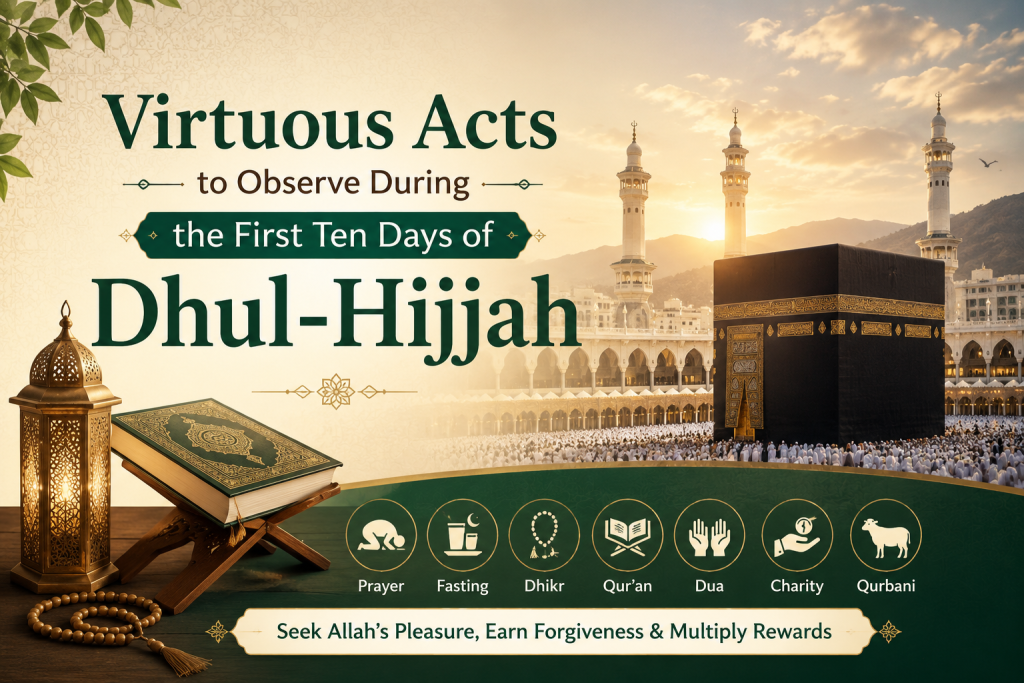
Virtuous Acts to Observe During the First Ten Days of Dhul-Hijjah
Among the most blessed and spiritually rewarding days in the Islamic calendar are the first ten days of Dhul-Hijjah. These sacred days hold immense virtue in the sight of Allah and present believers with a golden opportunity to increase their good deeds, seek forgiveness, and strengthen their connection with their Creator. Unfortunately, many Muslims often focus solely on Ramadan as a season of worship while overlooking the extraordinary significance of these ten days.
The first ten days of Dhul-Hijjah are so blessed that Allah Almighty swore by them in the Qur’an, highlighting their immense importance. During these days, acts of worship become more beloved to Allah, rewards are multiplied, and believers are encouraged to strive in righteousness.
For Muslims around the world, whether performing Hajj or remaining in their hometowns, these days provide an opportunity to renew faith, engage in worship, and prepare spiritually for the Day of Sacrifice (Yawm al-Nahr) and the blessed occasion of Eid al-Adha.
This article explores the virtues of the first ten days of Dhul-Hijjah and the righteous acts Muslims should observe to maximize the blessings of this sacred period.
The Virtue and Significance of the First Ten Days of Dhul-Hijjah
Before discussing the righteous deeds to observe, it is essential to understand why these days are so special.
Allah Almighty says in the Qur’an:
“By the dawn; and by the ten nights.”
(Surah Al-Fajr 89:1–2)
Many scholars of Tafsir, including Ibn Kathir and Ibn Abbas (may Allah be pleased with them), explained that the “ten nights” refer to the first ten days of Dhul-Hijjah.
Moreover, the Messenger of Allah ﷺ emphasized the greatness of righteous deeds performed during these days.
The Prophet ﷺ said:
“There are no days on which righteous deeds are more beloved to Allah than these ten days.”
The companions asked:
“Not even jihad in the path of Allah?”
He ﷺ replied:
“Not even jihad in the path of Allah, except for a man who goes out with his life and wealth and returns with neither.”
(Sahih al-Bukhari)
This Hadith clearly demonstrates the extraordinary status of these days. Good deeds performed during this period surpass deeds performed at almost any other time of the year.
The uniqueness of these ten days lies in the fact that major acts of worship come together during them:
- Salah (prayer)
- Fasting
- Charity
- Dhikr (remembrance of Allah)
- Hajj
- Sacrifice (Qurbani/Udhiyah)
- Repentance
No other days combine such a broad range of worship simultaneously.
Increase in Prayer (Salah)
One of the most virtuous acts during the first ten days of Dhul-Hijjah is increasing devotion to Salah.
Prayer is the pillar of Islam and the strongest connection between a servant and Allah. During these blessed days, Muslims should strive not only to perform their obligatory prayers punctually but also to increase voluntary prayers (Nafl).
Ways to Improve Salah During These Days
Pray the Five Daily Prayers on Time
Ensure every obligatory prayer is offered at its prescribed time with concentration and humility.
Allah says:
“Indeed, prayer has been decreed upon the believers a decree of specified times.”
(Surah An-Nisa 4:103)
Observe Sunnah and Nafl Prayers
Extra prayers increase closeness to Allah. Among them:
- Sunnah Rawatib (regular Sunnah prayers)
- Tahajjud (night prayer)
- Duha prayer
- Additional Nafl Salah
The Prophet ﷺ said that Allah says:
“My servant continues to draw near to Me with voluntary deeds until I love him.”
(Sahih al-Bukhari)
Pray in Congregation
Men should strive to pray in the mosque, while women should maintain devotion and concentration in prayer at home.
These ten days are a chance to revive spiritual discipline and consistency in worship.
Fasting During the First Nine Days
Fasting is among the greatest acts of devotion during Dhul-Hijjah.
Although fasting all nine days is not obligatory, many scholars encourage believers to fast as much as possible.
The wives of the Prophet ﷺ reported:
“The Messenger of Allah ﷺ used to fast the first nine days of Dhul-Hijjah.”
(Abu Dawud)
Fasting cultivates patience, sincerity, gratitude, and self-control.
The Special Importance of Fasting on the Day of Arafah
Among these blessed days, the 9th of Dhul-Hijjah (Day of Arafah) is particularly significant for Muslims not performing Hajj.
The Prophet ﷺ said:
“Fasting on the Day of Arafah expiates the sins of the previous year and the coming year.”
(Sahih Muslim)
Imagine earning forgiveness for two years through one sincere fast.
However, pilgrims performing Hajj are discouraged from fasting on Arafah because they require strength for worship and supplication.
Benefits of Fasting During Dhul-Hijjah
- Spiritual purification
- Increased patience
- Greater mindfulness of Allah
- Forgiveness of sins
- Increased reward
Even if fasting all nine days feels difficult, one should at least strive to fast on the Day of Arafah.
Engage Abundantly in Dhikr (Remembrance of Allah)
One of the easiest yet most rewarding acts during the first ten days of Dhul-Hijjah is increasing remembrance of Allah.
Allah says:
“And mention the name of Allah on known days.”
(Surah Al-Hajj 22:28)
Scholars explain that the “known days” refer to the first ten days of Dhul-Hijjah.
The Prophet ﷺ encouraged Muslims to frequently recite:
- Takbir — Allahu Akbar
- Tahmid — Alhamdulillah
- Tahlil — La ilaha illa Allah
- Tasbih — SubhanAllah
The Prophet ﷺ said:
“There are no days greater before Allah or in which good deeds are more beloved to Him than these ten days, so increase in them your declaration of the oneness of Allah (Tahlil), exaltation of Him (Takbir), and praise of Him (Tahmid).”
(Ahmad)
Recommended Dhikr
Takbir
Recite frequently:
Allahu Akbar, Allahu Akbar, La ilaha illa Allah, Allahu Akbar, Allahu Akbar wa lillahil-hamd
Istighfar
Seek forgiveness abundantly:
Astaghfirullah wa atubu ilayh
Sending Salawat upon the Prophet ﷺ
Increase blessings upon Prophet Muhammad ﷺ:
Allahumma salli ‘ala Muhammad
Dhikr requires no wealth, no effort, and no special place, yet its reward is immense.
Read and Reflect on the Qur’an
The Qur’an should occupy a central place in a Muslim’s worship during Dhul-Hijjah.
Many Muslims become spiritually active only during Ramadan, but the first ten days of Dhul-Hijjah are another excellent opportunity to reconnect with Allah’s Book.
Practical Qur’an Goals
You may:
- Read one Juz daily
- Complete one full recitation
- Read translation and Tafsir
- Memorize short Surahs
- Reflect deeply on meanings
Allah says:
“This is a blessed Book which We have revealed to you, that they might reflect upon its verses.”
(Surah Sad 38:29)
Instead of wasting time on entertainment or unnecessary scrolling, dedicate daily moments to the Qur’an.
Even reading a few pages consistently can transform the heart.
Increase in Dua (Supplication)
The first ten days of Dhul-Hijjah are precious moments to call upon Allah.
Dua is an act of worship that demonstrates humility, dependence, and sincerity.
The Prophet ﷺ said:
“Dua is worship.”
(Tirmidhi)
These sacred days are ideal for asking Allah for:
- Forgiveness
- Guidance
- Good health
- Halal sustenance
- Protection from trials
- Success in this life and the Hereafter
- Entry into Jannah
The Day of Arafah: A Day of Powerful Supplication
The Prophet ﷺ said:
“The best supplication is the supplication on the Day of Arafah.”
(Tirmidhi)
Spend this day making heartfelt dua for yourself, family, community, and the Ummah.
Ask Allah sincerely, as He loves those who turn to Him.
Strengthen Your Faith, Seek Guidance & Support Islamic Da’wah with Islami Dawah Center (IDC)
As you strive to maximize the blessings of the first ten days of Dhul-Hijjah, remember that true success lies in strengthening your connection with Allah, seeking authentic Islamic knowledge, helping others, and supporting righteous causes that continue to benefit the Ummah.
At Islami Dawah Center (IDC), our mission is to provide authentic Islamic guidance, education, Ruqyah support, and charitable services for Muslims in Saudi Arabia, Bangladesh, and worldwide.
Whether you are seeking Islamic healing, authentic answers to religious questions, quality Islamic education for your children, or opportunities to support Islamic da’wah, we warmly welcome you.
Authentic Islamic Ruqyah Service (Qur’anic Healing)
Are you or your family struggling with spiritual distress, anxiety, unexplained difficulties, evil eye (Ayn), black magic (Sihr), or Jinn-related concerns?
IDC provides Islamic Ruqyah services based strictly on the Qur’an and authentic Sunnah, avoiding superstition, shirk, or un-Islamic practices.
Our Ruqyah services focus on:
✔ Qur’anic healing through authentic recitation
✔ Protection from evil eye (Nazar)
✔ Guidance regarding Sihr (Black Magic) concerns
✔ Spiritual counseling and Islamic support
✔ Daily Islamic protection routines (Adhkar & Duas)
✔ Family spiritual guidance
We believe that ultimate healing comes from Allah alone:
“And We send down of the Qur’an that which is healing and mercy for the believers.”
(Surah Al-Isra 17:82)
If you or your loved ones need Islamic spiritual support, contact us for guidance and Ruqyah consultation.
Enroll Your Children in IDC English Medium Madrasha
Looking for an Islamic education that combines authentic Islamic learning with modern education?
The IDC English Medium Madrasha is dedicated to nurturing the next generation of Muslims with proper Islamic values, Qur’anic understanding, moral character, and educational excellence.
Why Choose IDC English Medium Madrasha?
✅ Islamic values-based education
✅ Qur’an learning with Tajweed
✅ English medium curriculum
✅ Islamic manners and Akhlaq development
✅ Faith-centered environment
✅ Guidance for children growing up in modern society
In today’s challenging world, Muslim children need both Islamic identity and academic confidence. IDC aims to prepare students to succeed in both Dunya and Akhirah.
Parents in Saudi Arabia, Bangladesh, and worldwide are encouraged to contact us for admission details and educational guidance.
Ask Authentic Islamic Questions & Receive Guidance
Do you have questions about:
- Salah (Prayer)
- Fasting
- Zakat
- Marriage & Family Issues
- Islamic Finance
- Aqeedah (Belief)
- Halal & Haram matters
- Ruqyah-related questions
- Hajj & Umrah guidance
- Daily Islamic rulings
IDC provides an Islamic Question & Answer Service to help Muslims understand Islam according to the Qur’an and authentic Sunnah.
In an age of misinformation and confusion online, it is important to receive answers grounded in authentic Islamic teachings.
Allah says:
“Ask the people of knowledge if you do not know.”
(Surah An-Nahl 16:43)
If you are confused about any Islamic matter, do not hesitate to seek guidance.
Support Islamic Da’wah — Donate to IDC Foundation
One of the greatest deeds during blessed days such as Dhul-Hijjah is Sadaqah (charity).
By supporting IDC Foundation, you become part of spreading Islamic knowledge, supporting educational programs, helping communities, and strengthening authentic Islamic outreach.
Your donation can help support:
✔ Islamic education programs
✔ Da’wah activities
✔ Qur’an learning initiatives
✔ Ruqyah and counseling support
✔ Educational outreach for children
✔ Islamic awareness projects worldwide
The Prophet ﷺ said:
“The most beloved people to Allah are those who are most beneficial to people.”
Even a small contribution can become an ongoing charity (Sadaqah Jariyah) that continues rewarding you long after you have passed away.
Support the mission of authentic Islamic guidance and da’wah today.
Contact Islami Dawah Center (IDC)
For Ruqyah Service, IDC English Medium Madrasha Admission, Islamic Question & Answer Service, or Donations, please contact us:
WhatsApp & Call (Available Worldwide)
📞 Saudi Arabia: +966549485900
📞 Saudi Arabia: +966553227950
📞 Bangladesh: +8801716988953
WhatsApp Available on All Numbers
📧 Email: IslamiDawahCenter16@gmail.com
📧 Email: info@islamidawahcenter.com
🌍 Website: Islami Dawah Center Official Website
Begin Your Journey Toward Islamic Guidance Today
Do not miss the opportunity to strengthen your faith, protect your family, educate your children, seek authentic Islamic answers, and support the noble mission of spreading Islam.
May Allah accept your worship during the blessed days of Dhul-Hijjah and make us among those who benefit humanity through sincere faith, knowledge, and righteous action. Ameen.
Frequently Asked Questions (FAQ) About the First Ten Days of Dhul-Hijjah
What are the first ten days of Dhul-Hijjah?
The first ten days of Dhul-Hijjah are the opening ten days of the 12th and final month of the Islamic calendar. These days are among the most blessed and sacred days in Islam, during which righteous deeds are especially beloved to Allah.
The Prophet ﷺ said:
“There are no days on which righteous deeds are more beloved to Allah than these ten days.”
(Sahih al-Bukhari)
These days include major acts of worship such as prayer, fasting, charity, Dhikr, Hajj, and Qurbani (sacrifice).
Why are the first ten days of Dhul-Hijjah so important?
The first ten days of Dhul-Hijjah are important because Allah swore by them in the Qur’an:
“By the dawn; and by the ten nights.”
(Surah Al-Fajr 89:1–2)
Islamic scholars explain that these “ten nights” refer to the first ten days of Dhul-Hijjah. During this period, rewards for good deeds are multiplied, sins may be forgiven, and believers have a unique opportunity to draw closer to Allah.
Which deeds are most virtuous during the first ten days of Dhul-Hijjah?
Some of the best acts of worship include:
- Performing the five daily prayers on time
- Offering extra voluntary prayers (Nafl Salah)
- Fasting, especially on the Day of Arafah
- Reciting the Qur’an
- Making abundant Dhikr (remembrance of Allah)
- Giving charity (Sadaqah)
- Making sincere Dua (supplication)
- Seeking forgiveness (Istighfar)
- Performing Qurbani/Udhiyah
- Helping family, relatives, and the needy
The key is to increase righteous deeds consistently throughout these blessed days.
Is fasting all ten days of Dhul-Hijjah mandatory?
No, fasting during the first ten days of Dhul-Hijjah is not obligatory, but it is highly recommended.
Many scholars encourage fasting the first nine days, especially the Day of Arafah (9th Dhul-Hijjah).
However, Muslims should not fast on Eid al-Adha (10th Dhul-Hijjah) because fasting on Eid is prohibited.
What is the reward for fasting on the Day of Arafah?
Fasting on the Day of Arafah carries tremendous rewards for those not performing Hajj.
The Prophet ﷺ said:
“Fasting on the Day of Arafah expiates the sins of the previous year and the coming year.”
(Sahih Muslim)
This means Allah may forgive sins from both the past and coming year through sincere fasting.
Should pilgrims performing Hajj fast on the Day of Arafah?
No. Pilgrims performing Hajj are generally discouraged from fasting on the Day of Arafah.
This is because they need physical strength for worship, standing in Arafah, making dua, and completing the rites of Hajj.
The Prophet ﷺ did not fast on Arafah while performing Hajj.
What Dhikr should be recited during the first ten days of Dhul-Hijjah?
Muslims are encouraged to increase in:
Takbir
Allahu Akbar (Allah is the Greatest)
Tahmid
Alhamdulillah (All praise belongs to Allah)
Tahlil
La ilaha illa Allah (There is no deity worthy of worship except Allah)
Tasbih
SubhanAllah (Glory be to Allah)
A commonly recited Takbir is:
Allahu Akbar, Allahu Akbar, La ilaha illa Allah, Allahu Akbar, Allahu Akbar wa lillahil-hamd
Try to recite these frequently at home, while walking, driving, or during daily activities.
Can women also benefit from the blessings of Dhul-Hijjah?
Absolutely.
Women can fully participate in the blessings of Dhul-Hijjah through:
- Prayer
- Dhikr
- Dua
- Charity
- Qur’an recitation
- Fasting (when applicable)
- Teaching children Islam
- Helping family and community
Even women who are menstruating can continue engaging in Dhikr, Dua, charity, Islamic learning, and listening to Qur’an.
What is Qurbani (Udhiyah), and who should perform it?
Qurbani (Udhiyah) is the sacrifice of an animal during Eid al-Adha in remembrance of the devotion and obedience of Prophet Ibrahim (AS).
Muslims who are financially capable are encouraged to perform Qurbani.
Allah says:
“So pray to your Lord and sacrifice.”
(Surah Al-Kawthar 108:2)
The meat is often shared among family, friends, and the needy.
Can I perform Qurbani online or through an Islamic organization?
Yes.
Many Muslims choose trusted Islamic organizations to perform Qurbani on their behalf, especially when helping poor families in different countries.
Before donating, ensure the organization follows Islamic guidelines and distributes meat responsibly.
Should a person avoid cutting hair and nails before Qurbani?
Yes, according to many scholars, a person intending to offer Qurbani should avoid cutting hair and nails after the beginning of Dhul-Hijjah until the sacrifice is completed.
The Prophet ﷺ said:
“When the ten days begin and one of you intends to offer a sacrifice, let him not remove anything from his hair or skin.”
(Sahih Muslim)
This ruling applies to the individual offering the sacrifice.
What is the best Dua on the Day of Arafah?
The Prophet ﷺ said:
“The best supplication is the supplication on the Day of Arafah.”
(Tirmidhi)
Among the greatest duas to recite is:
La ilaha illa Allah wahdahu la sharika lah, lahul-mulk wa lahul-hamd wa huwa ‘ala kulli shay’in qadir
Meaning:
“There is no god worthy of worship except Allah alone without partner. To Him belongs dominion and praise, and He has power over all things.”
Is charity more rewarding during Dhul-Hijjah?
Yes.
Giving charity during blessed days increases rewards and blessings. Supporting the poor, feeding people, helping Islamic causes, sponsoring education, and assisting those in need are all highly virtuous deeds during Dhul-Hijjah.
Even a small act of generosity can carry immense reward in the sight of Allah.
What mistakes should Muslims avoid during Dhul-Hijjah?
Common mistakes include:
❌ Treating these days like ordinary days
❌ Neglecting prayer
❌ Missing the Day of Arafah fast
❌ Forgetting Dhikr and Takbir
❌ Delaying repentance
❌ Wasting time excessively on entertainment
❌ Ignoring charity opportunities
❌ Performing innovations (Bid‘ah) without evidence
Instead, Muslims should focus on sincere worship and authentic Sunnah practices.
Can I still gain rewards if I am not performing Hajj?
Yes — absolutely.
Even Muslims who are not performing Hajj can earn immense rewards through:
- Fasting
- Prayer
- Charity
- Dhikr
- Qur’an recitation
- Dua
- Repentance
- Helping others
The blessings of Dhul-Hijjah are open to all believers worldwide.
How can busy Muslims maximize these ten days?
If you have a busy schedule, try this daily checklist:
✅ Pray all Salah on time
✅ Read at least a few pages of Qur’an
✅ Make morning and evening Dhikr
✅ Give daily charity, even a small amount
✅ Make sincere Dua after prayers
✅ Fast if possible
✅ Avoid sins and bad habits
✅ Increase Istighfar
Small consistent actions can bring enormous rewards.
How can I seek authentic Islamic guidance during Dhul-Hijjah?
If you have questions regarding:
- Fasting
- Salah
- Qurbani
- Hajj and Umrah
- Family matters
- Ruqyah
- Halal and Haram issues
- Daily Islamic rulings
You may seek authentic Islamic guidance through:
🌍 Islami Dawah Center Official Website
📱 WhatsApp Available:
Saudi Arabia: +966549485900 / +966553227950
Bangladesh: +8801716988953
📧 Email: IslamiDawahCenter16@gmail.com
📧 Email: info@islamidawahcenter.com
Final Reminder
The first ten days of Dhul-Hijjah are a priceless opportunity that returns only once a year. Do not let these sacred days pass without increasing your worship, seeking forgiveness, helping others, and drawing closer to Allah.
May Allah accept our deeds, forgive our sins, and bless us to witness many more blessed Dhul-Hijjah seasons. Ameen.
Internal Links
Use these naturally inside the blog post to improve SEO, engagement, and conversions.
Ruqyah Service Internal Link
If you are facing spiritual distress, evil eye, black magic concerns, or need Islamic healing guidance, explore our professional Ruqyah Service for authentic Qur’anic support.
Suggested URL:https://islamidawahcenter.com/ruqyah-service
Islamic Question Answer Service Internal Link
If you have questions regarding fasting, Qurbani, Salah, or Islamic rulings during Dhul-Hijjah, use our Islamic Question Answer Service for authentic guidance.
Suggested URL:https://islamidawahcenter.com/islamic-question-answer-service
IDC English Medium Madrasha Internal Link
Parents seeking Islamic and modern education for their children may learn more about our IDC English Medium Madrasha programs.
Suggested URL:https://islamidawahcenter.com/idc-english-medium-madrasha
Donation / Charity Internal Link
One of the best deeds during Dhul-Hijjah is charity. Support Islamic education and Da’wah through our Donate to IDC Foundation initiative.
Suggested URL:
https://islamidawahcenter.com/donate-to-idc-foundation/
Contact Page Internal Link
Need personal guidance regarding worship, Ruqyah, or Islamic education? Please contact Islami Dawah Center for assistance.
Suggested URL:https://islamidawahcenter.com/contact
External Links
Qur’an Reference
Sample Sentence:
To read the Qur’anic verses regarding sacrifice and worship, visit Quran.com.
URL:https://quran.com
Hadith Reference
Readers may verify authentic Hadith regarding the virtues of Dhul-Hijjah through Sunnah.com.
URL:https://sunnah.com
Hajj & Dhul-Hijjah Information
For official Hajj guidance and pilgrim updates, visit the Ministry of Hajj and Umrah Saudi Arabia website.
URL:https://haj.gov.sa
About the Author
Mahbub Osmane (طالبُ العلم، وداعيةٌ إلى الله) is a student of Islamic knowledge and a dedicated caller to the path of Allah, actively engaged in spreading authentic Islamic teachings based on the Qur’an and Sunnah. Through Islamic education, Da’wah initiatives, Ruqyah guidance, and community support, he strives to help Muslims strengthen their faith, gain beneficial knowledge, and practice Islam correctly in daily life.
He regularly writes and shares educational Islamic content covering topics such as Aqeedah (Islamic belief), worship, Ruqyah, family guidance, spiritual purification, Islamic education, and contemporary issues affecting Muslims worldwide. His mission is to promote authentic Islamic understanding, encourage righteous action, and support individuals and families through beneficial knowledge and compassionate guidance.
As part of the mission of Islami Dawah Center (IDC), Mahbub Osmane contributes to Islamic outreach, educational services, Islamic Question & Answer support, and initiatives aimed at benefiting Muslims in Saudi Arabia, Bangladesh, and worldwide.
📧 Email: hi@islamidawahcenter.com
🌍 Website: Islami Dawah Center Official Website
📱 Mobile: KSA: +966549485900 Bangladesh: +8801716988953
📍 Address: 2282 7284 Al Malawi Southern 1, As Sulimaniyah Dist, Makkah 24236, Saudi Arabia
May Allah make beneficial knowledge a source of guidance, mercy, and continuous reward for all. Ameen.